Control across locations. Confidence during service.
Review system compatibility, data ownership, payments, permissions and rollout before your first location goes live. Keep your teams in control as you expand.
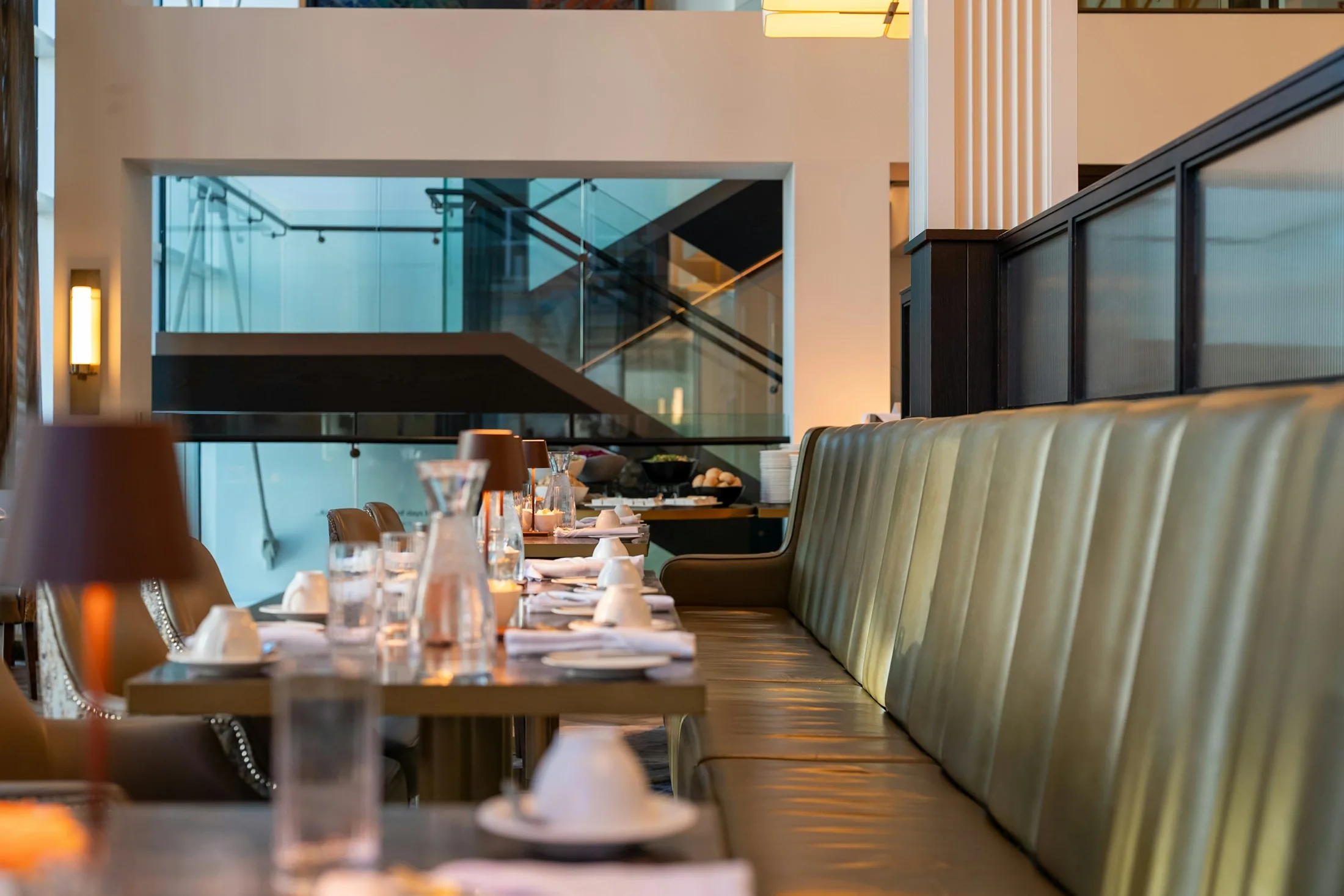
From approval to launch, typically up to three weeks.
Define responsibilities before configuration: one client lead, the system owners, the approval path and the people supporting service. Then prove the journey and launch in stages.
- 01Before kickoff
Map the environment
Confirm systems, owners, access, locations, channels, and success measures.
- 02Week 1
Build the foundation
Configure brand voice, menu and policy knowledge, permissions, and environments.
- 03Week 2
Connect the service
Implement provider integrations, guest channels, handoffs, and operating workflows.
- 04Week 3
Prove, train, launch
Complete QA, team training, production readiness, and a staged go-live.
Timing begins when required access, data, and approvals are available. Complex, custom, or multi-brand deployments may be phased by system or location.
Confirm the connections that matter.
Start with the systems needed for one guest journey. Agree the provider, data, permitted actions, handoffs and test criteria before enabling a connection.
- 01Scope each connection with its system owner.
- 02Confirm which context transfers automatically and which steps need the team.
- 03One layer in the middle; your systems of record stay yours.
Integration scope is agreed before launch.
View systems and connections
The operating stack, connected.
Use this checklist to scope your deployment. Exact provider compatibility, access and permitted actions are confirmed before launch.
| System | What connects | Status |
|---|---|---|
| POS & ordering | Order routing, status, and reconciliation | Confirm scope |
| Reservations | Availability, holds, confirmations, and changes | Confirm scope |
| Payments | Tokenized hosted checkout through the restaurant’s provider | Confirm scope |
| CRM & loyalty | Identity, preferences, history, and rewards | Confirm scope |
| Voice & telephony | Multilingual inbound service and human routing | Confirm scope |
| Web, messaging & QR | Branded guest channels and shared context | Confirm scope |
| Menus & knowledge | Approved menu, policy, and availability sources | Confirm scope |
| Analytics & operations | Events, outcomes, and operator briefings | Confirm scope |
A listed system category is an evaluation area. Enable a connection after its provider, data, permissions and operating handoffs are agreed and tested.
White-label is architecture, not a coat of paint.
Ownership is structural. Every deployment carries the restaurant’s identity, voice, menu, and knowledge — and everything the platform learns strengthens the relationship you own.
The only name guests see
Identity, voice, and design are yours end to end. Restaurant Companion never appears — guests simply experience your hospitality.
Relationships that belong to you
Recognition, preferences, and history accrue to your brand — not to a third-party app sitting between you and your guests.
Menus, policies, and voice — governed
Structured knowledge with versioning and content governance. What the host knows is what you approve, updated dynamically as your operation changes.
Intelligence that stays home
Guest intelligence and operational intelligence exist to serve your decisions and your relationships — they belong to your organization.
 AXIONARI
One operating view. Clear local responsibilities.
Give each brand and location its approved knowledge, access and workflows. Confirm how guest context reaches existing systems and who takes over when an exception needs a person.
Secure by design — not by exception.
Every layer of the platform assumes it will be examined. These are the principles your security team will find when it looks.
01Encryption everywhere
Data is encrypted in transit and at rest. Keys and secrets live in managed secret stores — never in code, never in configuration files.
02Identity & access
Enterprise authentication with role-based authorization. Every user, service, and integration operates under least-privilege access.
03Audit logging
Administrative and data access is logged and attributable. What happened, who did it, and when — answerable at any time.
04Infrastructure security
Isolated environments, hardened infrastructure, and continuous patching on cloud platforms built for enterprise workloads.
05Secure development
Code review, dependency scanning, and staged releases are part of the engineering discipline — not an afterthought.
06Data isolation
Tenant data is isolated by architecture. One brand’s guests, menus, and knowledge are never visible to another’s.
Guest trust is infrastructure.
Restaurant Companion remembers what improves hospitality — and nothing more. Privacy is not a policy layered on top of the platform. It is how the data model was designed.
- 01Your guests remain your guests — data belongs to the restaurant.
- 02Data minimization — only what serves the guest is remembered.
- 03Consent, managed — recognition happens when appropriate and permitted.
- 04Retention with limits — nothing is kept without a reason.
- 05Deletion requests follow the agreed process and retention rules.
Card data never touches the host.
Checkout is tokenized and handled by enterprise payment providers inside the conversation. Restaurant Companion orchestrates the payment — your provider processes it. Sensitive card data stays where it belongs: with the processor, never with the platform.
- 01Tokenized, PCI-conscious checkout through enterprise providers.
- 02Hosted payment fields — card details are never entered in the app itself.
- 03Payment data isolated from conversation and guest data.
- 04Clean reconciliation into the financial systems you already run.
Card details are entered in Stripe’s secure form — never in this app.
Reliability is a discipline, not a promise.
No impossible uptime claims. Instead: separated environments, disciplined releases, and rollbacks planned before they’re ever needed — the operational habits that keep dinner service running.
01Environment separation
Development, staging, and production are fully separated. Nothing reaches guests without passing through the stages before it.
02Release management
Changes ship deliberately — reviewed, staged, and observable. Peak service hours are treated as sacred.
03Rollback, planned
Every release can be reversed. Rollback paths are designed before deployment, not improvised after.
04Monitoring & observability
The platform watches itself — health, latency, and behavior — so issues surface before guests notice them.
05Incident response
Clear ownership, defined escalation, honest communication. Incidents are managed, documented, and learned from.
06Continuity & scale
Elastic infrastructure absorbs Friday-night peaks, seasonal surges, and multi-location growth without re-architecture.
Stated plainly. Never oversold.
Two areas where enterprise diligence deserves straight answers — what our compliance posture is today, and how the intelligence in the platform is governed.
Honest today, ready for tomorrow
PCI-conscious payment architecture. GDPR- and CCPA-aligned data practices. A SOC 2 roadmap with internal governance and security reviews already in motion. We state only the certifications we hold — and architect for the ones that matter next.
Intelligence with oversight
The host speaks from curated restaurant knowledge — menus, policies, availability — not an open internet. Human oversight, continuous evaluation, and enterprise controls govern what it can say and do. Governance, not hype.
Technical depth stays in the room.
Eduardo Vertiz, Founder & CEO, brings more than 25 years building companies, leading complex operations, and forming strategic partnerships across hospitality, technology, entertainment, and live experiences. He conceived Axionari’s product strategy, enterprise architecture, and experience design.
Meet the leadership →The questions every enterprise asks.
Direct answers to the first questions technology and operations leaders raise in evaluation.
01Does Restaurant Companion replace our POS or reservation system?
Your POS, reservation and payment providers remain the systems of record. During solution design, we confirm which actions can connect and how exceptions reach your team.
02Who owns the guest data?
You do. Guest relationships, preferences, and history belong to the restaurant. Restaurant Companion processes data on your behalf under data minimization, with deletion on request.
03Where does card data live?
With your payment provider. Checkout uses tokenized, hosted payment forms from enterprise processors. Card data never touches Restaurant Companion.
04Can one deployment serve multiple brands?
Yes. The platform is multi-tenant by design — many brands, many locations, one intelligent layer, with complete isolation between tenants.
05How is the AI governed?
The host speaks from your approved knowledge — menu, policies, availability — under human oversight, continuous evaluation, and enterprise controls. It doesn’t improvise your brand.
06What does implementation look like?
Agree one location, the first guest journey, system access and named owners. We configure and test the scope, train the team and review pilot results before expansion.
Leave with a clear launch decision.
Bring operations, finance and your technology contact. We’ll define the first use case, required connections, team responsibilities and the evidence needed to justify a pilot.